
Adam Barr blogged bits and pieces of a PowerShell RPN calculator a few years ago: first the basics, and then some tweaks to clean it up. An RPN calculator, if you haven’t played with one before, flips the way you enter data. Rather than type “2 + 2”, you type “2 2 +”. RPN-style calculation supposedly has lots of great benefits. While I understand it and can do it, I wouldn’t say I “get it.”
Last week, I dropped by to be interviewed on the PowerScripting Podcast. We chatted about providers, eventing, transactions, security, and a whole slew of V2 improvements that you probably didn’t know about!
Give it a listen: http://powerscripting.wordpress.com/2009/09/27/episode-85-lee-holmes-talks-about-v2/
Call me as shocked as anybody, but the iPhone app store now has a new entry:
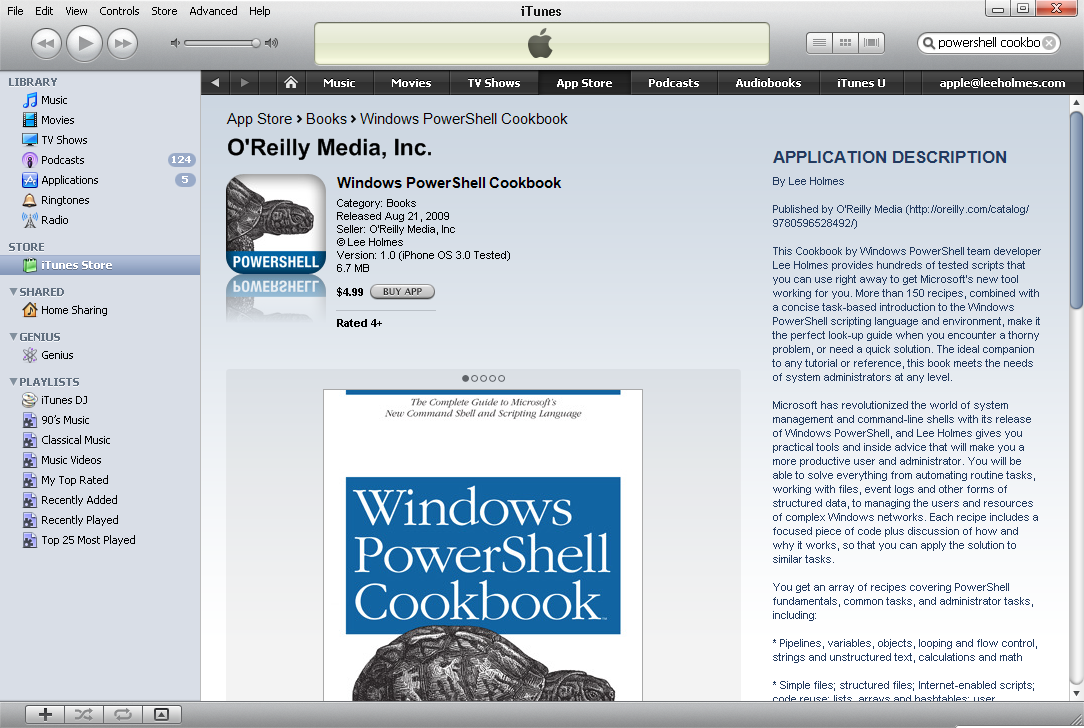
Although I can’t find any official information about it on the rest of the internet, O’Reilly has teamed up with Lexcycle (authors of the Stanza iPhone book reading application) to create iPhone applications for many of the top O’Reilly cookbooks.
Sometimes, people ask, “What’s the equivalent of NET HELPMSG” in PowerShell?
NET HELPMSG is probably the easiest to remember (and works in PowerShell of course,) but PowerShell improves the experience a bunch by way of the .NET Framework.
Suppose you get error 0x80070652 from an installer:
C:\Users\leeholm>net helpmsg 0x80070652
The syntax of this command is:NET HELPMSG
message#
Oops, it doesn’t support hex. You need to take the last 4 digits:
I wanted to download a photo album from Facebook, but of course there’s no simple API or option to do that. Searching the internet finds a couple of options (a Firefox plugin, a Facebook app,) but I couldn’t seem to find anything standalone.
This gives another great opportunity to talk about advanced HTTP scripting in PowerShell. We’ve talked about it in the past (here: http://www.leeholmes.com/blog/AdvancedHTTPASPNetScriptingWithPowerShell.aspx,) so this script introduces some new techniques.
Despite being a fan of security, I’ve always run Windows Update in “Download and Notify” mode for all of my machines. Having Windows Update reboot my machine without warning at 3:00 AM is just too destructive.
This has two negative effects:
- Security patches that don’t require a reboot are needlessly postponed.
- Programs that auto-update frequently via Microsoft Update turn into a permanent task-bar nag that you have updates to install.
After working with PowerShell for awhile, then starting to write scripts, you quickly learn about PowerShell’s Execution Policy and other security features. You might even throw up your hands, and ask, “Why is this configuration so HARD? Why can’t it be as easy as VBS and Perl?” You can double-click on a VBS or CMD script and have it run automatically. Those scripts could invoke PowerShell anyways, so why put all this effort into security?
In CTP2 of PowerShell v2, we added a new parameter to Get-Help: Online. This parameter lets help authors declare an “online version” of their help topic, which PowerShell then launches with your default browser. For the PowerShell cmdlet help topics, we redirect to the excellent (and more frequently updated) online cmdlet help topics: http://technet.microsoft.com/en-us/library/dd347701.aspx.
PowerShell supports online help content for both MAML-based help topics (http://msdn.microsoft.com/en-us/library/bb525433(VS.85).aspx, http://blogs.msdn.com/powershell/archive/2006/09/14/Draft-Creating-Cmdlet-Help.aspx, http://blogs.msdn.com/powershell/archive/2008/12/24/powershell-v2-external-maml-help.aspx) and inline help comments (http://technet.microsoft.com/en-us/library/dd819489.aspx.)
To add support for the –Online parameter to your own cmdlet help, add a maml:navigationLink element with a maml:uri node to the maml:relatedLinks section in your MAML help. The help system uses the first navigation link that contains a URI as the target for the link.
There are a few. Based on worldwide numbers (160 confirmed deaths, 3000 “suspected” cases)
- Falling out of bed (900 confirmed deaths)
- Falling down the stairs (1,690 confirmed deaths)
- Big storm (874 confirmed deaths)
- Drinking binge (346 confirmed deaths)
Of course, the statistic left out by the news
- Normal flu (36,000 confirmed deaths per year)
I got forwarded an addictive interactive sequencer yesterday (http://lab.andre-michelle.com/tonematrix) and was immediately hooked. I asked an internal mailing list if there was any kind of hardware that lets you do this kind of thing on the couch, and got the response – “you mean MIDI?” That’s close, but it is closer to a very simplified sequencer.
I play classical guitar… even being a fan of electronic music, I had never seen a sequencer used, or tried to make anything in one. I’m sure some researcher out there would love to have me for a “out of touch with reality” anthropology study.